
Sailing with Kids: How to Make it Fun and Safe for the Whole Family
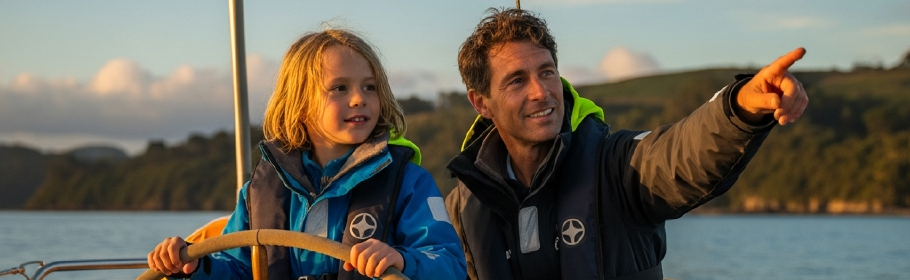
There’s a special moment when you see your child truly connect with being on the water: a small hand on the tiller, eyes fixed on the horizon as the boat glides through the waves. Of course, getting to that perfect afternoon means navigating the usual challenges of keeping our youngest crew members happy, engaged, and safe. It’s a balance that can feel tricky, but it’s simpler than you might think. In this article, I’ll share some personal advice for turning any family sail into a true adventure by focusing on two key ideas: practical safety and planned fun.
For me, the secret to a great family sail starts long before we cast off the lines. It begins with creating an environment where my kids feel secure, and I feel confident. Once that foundation is set, the fun happens naturally.
The first and most important piece of gear for my young crew is their Personal Flotation Device (PFD). A PFD that’s too big is almost as useless as no PFD at all, so I always perform a quick fit-check. With the PFD zipped and buckled, I lift it from the shoulders; if it rides up over their chin and ears, it’s too loose. For little ones, a crotch strap is non-negotiable to prevent the jacket from slipping over their head.
My core rule on the boat is that PFDs are mandatory anytime we’re in the cockpit or on deck. When they head below to grab a snack or use the head, it can come off, but the moment they step back up the companionway, it goes back on. It’s a simple routine that becomes second nature.
I think of my boat’s deck as a floating playpen, and a few key modifications make all the difference. When my kids were toddlers, lifeline netting was a game-changer for my peace of mind. For choppier days or passages, a properly fitted safety harness and tether are a must. I always explained that it isn’t a leash, but a special tool that keeps them connected to the boat.
But physical barriers are only half of it. I made sure to teach them the timeless sailor’s mantra: “One hand for you, and one for the boat.” It’s a simple phrase that has saved countless sailors from a slip or stumble.
Safety drills sound serious, but they don’t have to be scary. Instead of a “man overboard” drill, we play “Rescue the Fender!” I’ll toss a brightly colored fender overboard and the kids’ job is to be the official spotters. They have to point at it continuously while I maneuver the boat. It turns a critical skill into a fun, engaging game. Finally, our safety routine always includes sun protection. The “sailor’s uniform” is non-negotiable: a hat, sunglasses, a long-sleeved shirt, and sunscreen that gets reapplied right after lunch.
The single best way I’ve found to keep my kids engaged is to give them a real job. It’s the difference between being a bored passenger and being a valued member of the crew. The key is to match the task to their age and ability, giving them a sense of ownership over our journey.
For my youngest crew, when they were around ages 3 to 6, their jobs were simple but important. They were the official “Wildlife Spotters,” in charge of yelling “Dolphin!” or “Seal!” at the first sign of movement. During a calm docking, they became “Fender Managers,” responsible for holding a small fender and placing it between the boat and the dock on my command.
As they got a bit older, around ages 7 to 11, the responsibilities grew. This is the golden age for learning. I’ll never forget the look on my daughter’s face the first time she took the helm in open water. I also taught her how to tie a cleat hitch: a simple, useful knot she now executes perfectly every time we dock. This is also a great age for them to be a co-navigator, either by spotting the next channel marker or by following our icon on a tablet’s charting app.
Now that they’re teens, they can handle real responsibility. They can trim the jib to get the perfect sail shape, manage the anchor windlass, and help me plan our course for the day. Giving them this trust has not only made them better sailors but also more confident young adults.
Of course, even the most beautiful day of sailing can have its lulls. For those moments, I rely on a bit of planning.
First is the sacred “Boat Box.” It’s a waterproof bin that lives on the boat and is filled with things they can only play with while we’re sailing. For us, that means special LEGO kits, a waterproof deck of cards, art supplies, and, most importantly, snacks that I don’t normally buy. The novelty of the Boat Box has saved many an afternoon.
I also learned to make the destination a huge part of the adventure. The sail is just the first half of the fun. We talk about the hiking trail that starts at the head of the bay or the famous bakery in the harbor we’re heading to. The dinghy ride to a dock or beach is a “shore mission.” Getting off the boat to explore a quaint town, skip rocks on a stony beach, or tour a historic navy ship turns the boat into our floating basecamp. It reinforces that the boat isn’t just a vehicle; it’s our key to unlocking unique places you can’t get to any other way.
An all-day sail is a special kind of adventure, offering a real sense of journey and accomplishment. But a full eight or ten hours on the water requires a different rhythm and a bit more planning, especially when it comes to crew management and morale. I’ve found that success on these longer days comes down to managing energy: both the kids’ and my own.
I treat a long day like three distinct mini-sails. The morning is for high-energy engagement. That’s when the kids get their most important jobs: taking a turn at the helm, helping me trim the sails, or doing a navigation lesson where we plot our progress on a paper chart.
By midday, after lunch, energy naturally wanes. This is our designated quiet time. The “Boat Box” makes its appearance, or maybe we’ll listen to an audiobook together in the cockpit. I’m not above strategic screen time, either: a pre-downloaded movie on a tablet can be a lifesaver during that sleepy post-lunch slump, giving everyone a chance to recharge.
As the afternoon wears on and our destination gets closer, I bring them back into the action. How they help depends entirely on their age:
- For the little ones (3-6): I would turn our arrival into a spotting game. “Who can be the first to see the big red buoy?” or “Tell me when you see the clock tower in town!” It focused their attention outward and built excitement. They would also be in charge of “stowing gear,” like putting the binoculars back in their case before we get to the dock.
- For the mid-grades (7-11): This was a great time for them to be real deckhands. They helped get fenders out of the locker and tie them loosely to the lifelines. They were also my official “Depth Readers,” calling out the numbers from the chartplotter as we navigated into a cove.
- For teens: In their teenage years, they can take on real responsibility: preparing dock lines and fenders and discussing the best way to approach the dock or anchorage based on the wind and current.
On a long sail, food is more than just sustenance; it’s a major event that breaks up the day. My number one rule is to do as much prep as possible before we even leave the dock. I rely on pre-made wraps, one-pot meals like chili that can be easily heated up, and a whole lot of snacks. My best trick is to create a “Snack Bag” and make one of the kids the official “Snack Captain.” It gives them a sense of authority and prevents me from being asked for a snack every fifteen minutes.
When it’s just two adults managing everything, it’s crucial to avoid burnout. We use a simple watch system. One of us is the designated “Skipper.” For a 90-minute shift, that person is fully in charge: they are at the helm, they are watching the navigation, and they are the go-to parent for any kid-related needs.
The other parent is “off watch.” Their job is to genuinely relax. They can read a book, listen to music, or just watch the waves go by. They are still on deck and available to help with a maneuver if the Skipper asks (“Ready to tack?”), but they aren’t actively managing the boat or the children. After 90 minutes, we swap. This system ensures that one person is always focused and in command, while the other gets a real mental break. It’s the key to making sure we both end the day feeling refreshed, not frazzled.
Ultimately, sailing with my kids has taught me that a successful family trip isn’t about luck; it’s about preparation and perspective. By making safety an easy routine and actively planning for engagement, the boat transforms from a simple vessel into a floating classroom and our family’s basecamp for adventure.
The goal isn’t just to get through the day; it’s to raise a confident crewmate who loves being on the water as much as I do. The effort pays off in shared stories and a genuine connection that lasts a lifetime. These are some of the lessons I’ve learned along the way. Now I’d love to hear from you: what are your go-to tricks or favorite memories from sailing with your family? Share them in the comments below